
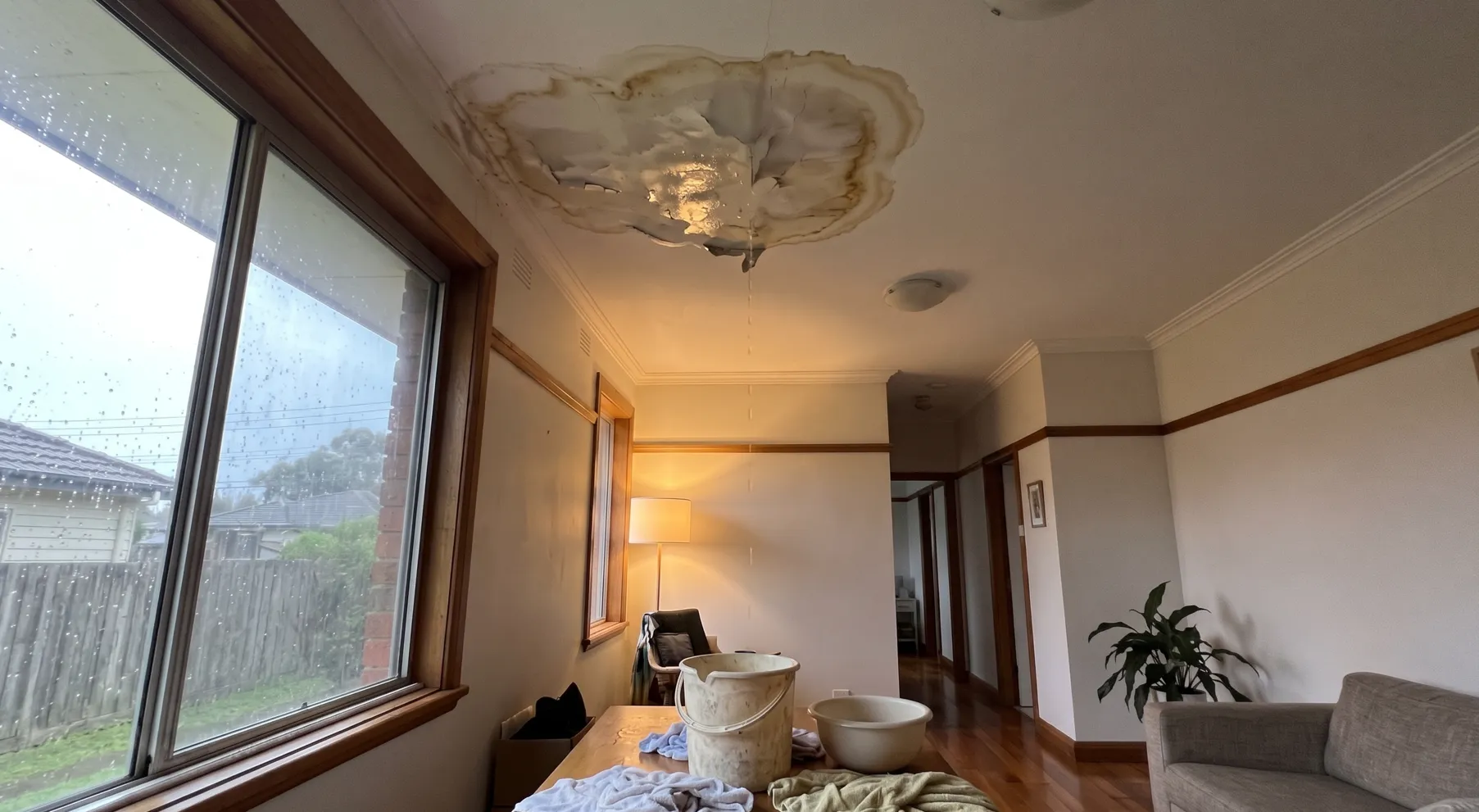
Most roof leaks in Narre Warren come from four places: perished ridge pointing, rusted or blocked valley irons, failed flashings, and cracked or slipped tiles. The water stain on your ceiling is rarely directly under the fault, but how the leak behaves in rain usually tells you which of the four it is. This guide shows you how to read those signs from the ground, what each fault costs to fix properly, and when a drip turns into an emergency.
What causes most roof leaks in Narre Warren?
Most Narre Warren roofs are concrete tile and several decades old, so the mortar and metal parts usually fail before the tiles.
The tiles on a concrete roof are tough. They lose their surface coating, grow lichen and look tired, but a sound concrete tile will keep shedding water for decades. The weak points are everything that joins tiles together or joins the roof to something else.
- Ridge and hip capping. The curved tiles along the peaks sit on a bed of mortar, finished with pointing along each side. Old cement pointing cracks, the bedding behind it washes out, and water gets in at the joins. This is the most common leak source on Narre Warren roofs from the 1970s and 1980s.
- Valley irons. Where two roof planes meet in an internal corner, a metal channel carries a large share of the roof’s water. Leaves, moss debris and broken tile fragments build up in it; water backs up under the tiles on either side; and older galvanised valleys rust through.
- Flashings. Any place the roof meets a wall, chimney, skylight, flue or solar mount relies on a strip of lead, aluminium or steel to keep water out. Old lead flashings split, silicone patches fail, and solar installation brackets are a regular source of new leaks.
- Cracked or slipped tiles. Someone walking on the roof (an antenna installer, a solar crew, a previous repair) cracks a tile, and the crack lets water through every time it rains.
Read the leak by the rain that causes it.
Each pattern points to a different family of faults.
| When the leak shows | Most likely source | Why |
| Every time it rains, even lightly | Cracked tile, failed flashing, hole in sarking under a broken tile | The water path is direct, so any rain finds it. |
| Only in heavy downpours | Blocked or undersized valley iron, overflowing box gutter, blocked downpipe | Water volume exceeds what the channel can carry and backs up under the tiles. |
| Only in wind-driven rain from one direction | Perished ridge pointing, gaps at gable ends, flashing on the exposed side | Wind pushes water sideways into joins that stay dry in still rain. |
| Days after the rain stops | Water trapped in a valley or saturated bedding draining slowly | The source is holding water, not just passing it. |
| On cold mornings with no rain | Condensation in the roof space, not a leak | Warm, moist air from the house meets a cold roof underside. |
The last row matters more than people expect. A damp patch that appears in winter with no rain is often a ventilation problem, and no amount of re-pointing will fix it.
Why does my roof only leak in heavy rain?
A roof that only leaks in heavy rain usually has a blocked or undersized valley iron, an overflowing gutter, or a blocked downpipe. The roof copes with normal rainfall, but in a downpour, the water backs up under the tiles or over the back of the gutter and into the eaves or ceiling.
Narre Warren’s summer storms are where this shows up. A valley that has been half-full of leaf litter for three years drains fine in a light shower but overflows in a 20-minute cloudburst. Check the gutters at the bottom of each valley first. If they are packed with debris or the downpipe outlet is blocked, that is your most likely culprit and often the cheapest fix on this list.
Why does my ceiling stain not line up with the leak?
Water that gets past a tile lands on the sarking (if the roof has any), a batten or a rafter, and runs downhill before it drops onto the ceiling. On a typical pitched roof, it can travel a metre or more. A stain near an external wall usually means the fault is higher up the same roof plane. A stain near the middle of the house often sits under a valley or a ridge line. A roofer who goes straight to the tiles above the stain and stops there may miss the real source.
How your home’s age predicts the fault
Narre Warren grew in waves, and each wave left a different set of roofs ageing at the same time.
The Fountain Gate estate, developed in the 1960s by Isador Magid with input from architect Robin Boyd, holds many of the suburb’s oldest houses. Parts of the estate, including Prospect Hill Road, are listed in the City of Casey heritage scheme, so check with council before changing the roof material or colour on those streets. Roofs of this age were commonly built without sarking, so a single cracked tile can drip straight onto the ceiling. Original lead flashings and galvanised valleys on these homes are well past their expected life.
The 1970s and 1980s estates that filled in around the shopping centre and the railway line make up the bulk of Narre Warren’s housing. These are mostly concrete tile roofs with mortar-bedded ridges and cement pointing. At 40-plus years old, the pointing is cracked, and the bedding has often lost its grip on the caps. This is the age group where ridge repairs come up most.
1990s and 2000s houses generally have sarking and newer flexible pointing, so they leak less, but they have their own problem: rooftop solar. A system fitted in the last 15 years means people walked the roof, drilled brackets through or under tiles, and ran cables through roof penetrations. Leaks that start in the first or second winter after a solar install are almost always connected to it.
What does a roof leak repair cost in Narre Warren?
Leak repairs are priced by the fault, not by the leak. A five-minute fix and a two-day job can produce the same drip on your ceiling. The figures below are indicative ranges for metropolitan Melbourne and will vary with roof height, pitch and access.
- Unblocking or clearing valley irons & gutters: $150 – $350
- Replacing individual cracked/slipped tiles: $200 – $450
- Flashing repairs or resealing solar penetrations: $300 – $750
- Re-bedding and re-pointing ridge caps: $1,200 – $2,800+ (depending on lineal metres)
The gap between the cheapest and dearest jobs here is why the diagnosis matters more than the quote. A roofer who only re-points the ridges when the actual problem is a blocked valley has charged you for the wrong job, and the leak will be back in the next storm.
Is a roof leak an emergency?
A roof leak is an emergency when water drips near light fittings, power points or the switchboard; when a ceiling sags; or when a storm has left an open section of roof. A slow drip into a bucket is urgent but not an emergency and can usually wait a day or two for a proper repair.
A sagging ceiling is the one to take seriously. Plasterboard holds a surprising amount of water before it gives way, and when it does, it comes down in one piece. If you see a bulge, keep people out of the room, put a bucket under it and, if you are comfortable doing so, make a small hole at the lowest point with a screwdriver to let the water drain in a controlled way. If water is anywhere near electrical fittings, turn off that circuit at the switchboard.
For a storm-damaged roof, a temporary tarp or tile reset buys time. It is not a repair, and it should be followed by a proper inspection once the weather clears. If you plan to file an insurance claim, photograph everything before anything is moved.
What to expect from a proper leak inspection
A good leak inspection starts inside, not on the roof. The roofer should look at the stain, go into the roof space if it is accessible, and trace the water path back towards the source before they climb up. On the roof, they should check the whole water path above the stain, including the valley, ridge and flashings, rather than replacing the tiles directly above it and leaving.
You should come away with photos of the fault, a plain explanation of the cause, and a quote for that fault alone. Be wary of an inspection that turns a single leak into a full roof restoration on the spot. A full restoration can be the right call for a roof that is failing in several places at once, but it should be a recommendation you can weigh, not a condition of fixing the leak.
Your next step
Note when your leak appears, check the gutters under the valleys, and take photos of the stain. If the gutters are clear and the leak keeps coming back, call Taylor & Son Roofing on 0402 439 107 to book a roof leak repair inspection in Narre Warren. Tell us which kind of rain brings it on, and we will know where to start looking.